Between the Rush: Finding room for a life in New York City

Photographs of movement, waiting, and the attention we carry through public space.
On a subway platform, a train passes the people seated on a bench. Its windows and doors stretch into blur, while the figures remain distinct. I return to the way these two kinds of time sit beside each other in one photograph: the train moving through the station and the people spending part of their day there.
Between the Rush is a New York City street-photography project about the room people make for themselves within the city's movement. The public gallery spans 2015 to 2025. Across its subway platforms, covered passages, and streets, I follow the relationship between a person and the space around them. A book opened at a table gives that relationship a different shape from a figure standing beside a moving train.

A platform bench and a passing train. From Between the Rush.
What Between the Rush is looking at
The city's pace is visible in its trains and traffic, but it also shapes where people stand, how they pass one another, and the places available for a pause. A bench on a subway platform gives someone somewhere to sit while a train moves beside them. A tiled wall turns a walk through a station into a narrow route, with posters and signs competing for attention.
I am interested in how a person remains present within those surroundings. In the platform photograph above, the seated figures and the blurred train share the frame. Both matter. Your eye can follow the length of the train, then return to the people on the bench. That movement between the larger setting and the individual is central to this work.

Walking beside the tiled station wall.
The figure beside the tiled station wall offers a different distance. We see someone from behind, moving through a space laid out for passage. The photograph leaves their destination open. I like having that room in an image: enough detail to notice a person, without pretending to know the life beyond the frame.
How the city shapes a photograph
Architecture gives these photographs much of their structure. An archway holds rows of tables within a deep, shaded passage. An umbrella and a passing figure briefly interrupt those repeating forms. The building at the far end gives the eye somewhere to go, while the nearer movement keeps the space from becoming only an architectural view.

A passing figure interrupts the repeating tables and archway.
Elsewhere, the frame moves closer to the street. A person pushing a wire cart occupies the foreground, with another pedestrian behind. Here the relationship between a body and the city is more immediate: hands on the cart, wheels against the pavement, a fence continuing along the route.
There is a limit to what a photograph tells us about a stranger. I can describe the cart, the gesture, and the arrangement of people in the frame. Their circumstances belong to them. I want to give the encounter attention while leaving the person their dignity and their own story.

A cart, a passing pedestrian, and the route along a fence.
Private attention in public places
Some of the photographs stay close to everyday acts that are easy to pass without noticing. At an outdoor table, a person looks down at an open book. A bottle and small belongings occupy the tabletop. Another reader sits behind them. The surrounding space is shared, but each person has something of their own to attend to.

Reading in a shared outdoor space.
A nighttime photograph carries that thought into a different setting. A figure near the curb looks at a phone, with colored vehicle lights behind them. The book and the phone give the two photographs a connection, although the light, distance, and setting change. Each shows an act of attention taking place within public life.
I cannot say what either person is reading, thinking, or waiting for. What interests me is the visible arrangement: the lowered gaze, the object held or opened, and the way the rest of the street remains around them. Those details are enough to spend time with.

Attention held near the curb at night.
Weather, movement, and a change of pace
Weather changes how a body occupies the street. An umbrella creates a small boundary around a person at a crossing. Its clear surface lets the surroundings remain visible while partly obscuring the figure beneath it. The wet roadway and the light beyond give that boundary a particular texture.

An umbrella makes a small boundary within the crossing.
Color and black-and-white photographs sit together in Between the Rush. In the black-and-white frames, I find myself following the station's lines, the shape of a gesture, or the space between figures. In the color work, a yellow platform edge or the lights behind a person can carry my attention across the picture. Seeing these photographs together gives the series changes of pace.
The platform photograph below returns to one of the project's clearest relationships. A train stretches into horizontal blur while a figure stands near a column. There is movement across much of the image, with a person giving the eye a place to settle. It connects back to the opening photograph without repeating its distance or arrangement.
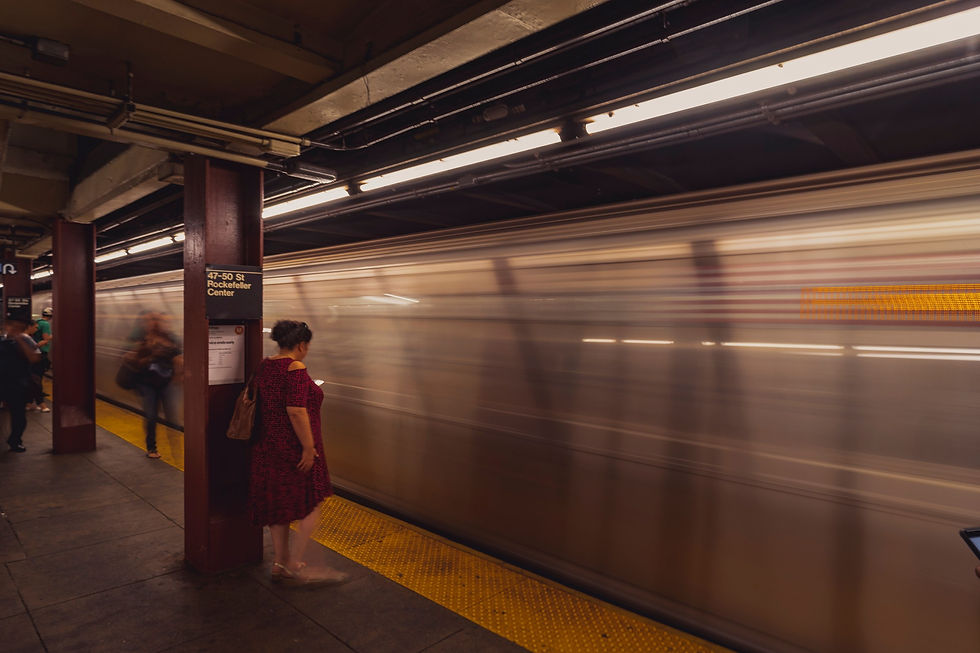
A still figure beside a moving train.
Back toward the street
The Prince Street station photograph takes the movement upward. Railings cross the frame around a person climbing the stairs, and the station sign fixes the encounter in a particular place. After the broad horizontal movement of the trains, this narrow ascent changes the direction of the sequence.
I like leaving the article here, with someone continuing beyond the platform. The opening photograph gives us a place to wait; this one gives us a route out. Looking between them, I notice how differently the city arranges a pause and a passage.
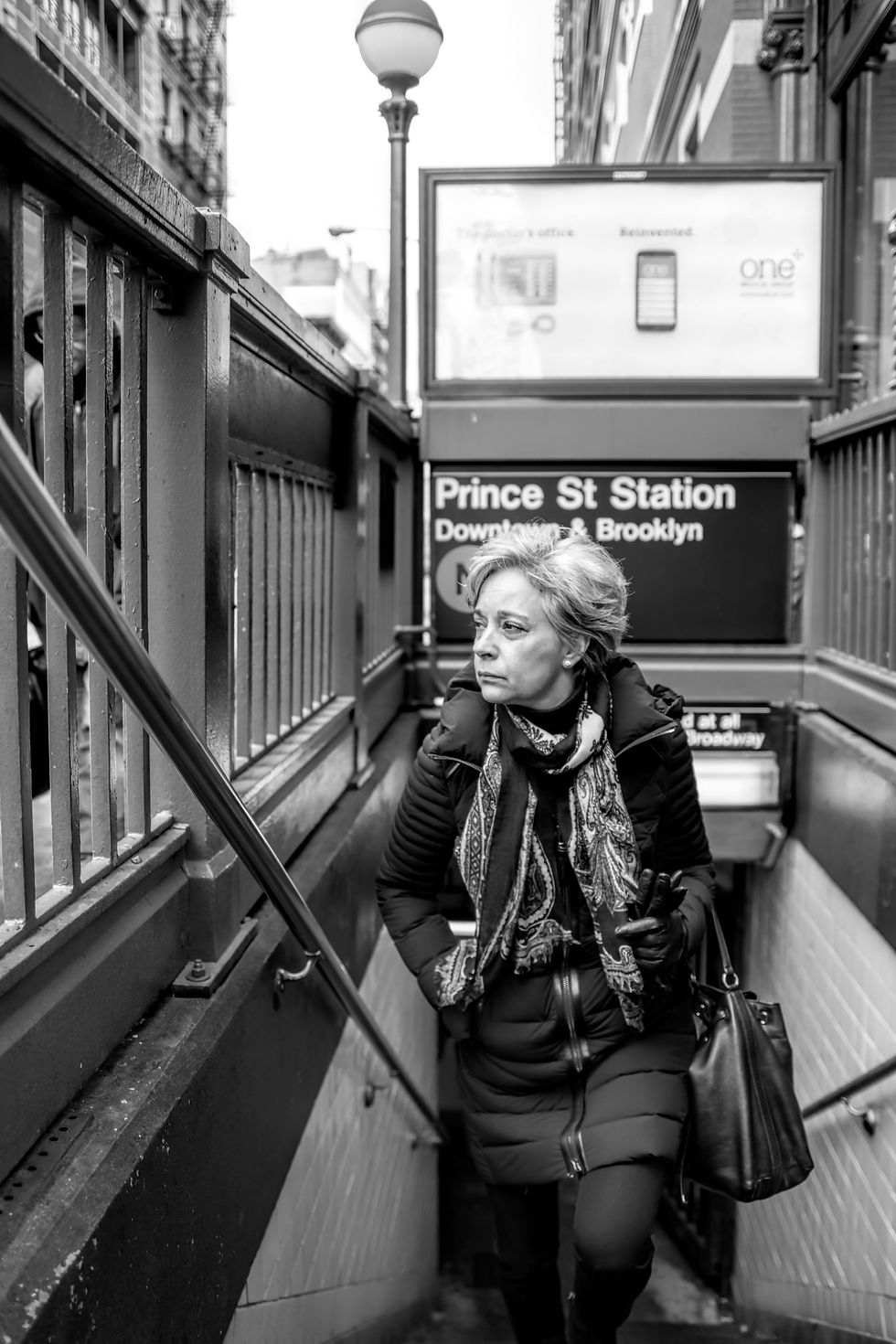
Climbing toward the street at Prince Street station.
Explore or collect Between the Rush
The full project brings together all 20 photographs. If you would like to spend more time with these connections, you can follow the complete sequence in the project gallery.
Photographic prints and framed works are available through the purchase gallery. The magazine includes all 20 photographs in a 20-page, 8.5-inch-square matte format, with two identical copies per purchase. I would be glad for you to find a photograph you want to keep, or to choose the magazine as a way to experience the complete series.
Ramon Trotman Ramon Trotman Perspective